
Hi Phil here (founding creator of fat-loss-quest.co.uk) with some critical information on this widely used weight loss protocol.
If you have tried counting the calories to lose weight and failed, were planning on using calorie counting (either on your own or with an established company), you will want to read this post that reveals the truth about calorie counting for weight loss and the upcoming guide that reveals how you can use this method effectively AND learn how it becomes irrelevant when you engage in smart food swaps to healthier choices .
For decades, mainstream diet advice has hammered the exact same message into our heads: “Weight loss is just a simple math equation—calories in versus calories out.”
We were told that as long as we stayed in a caloric deficit, it didn’t matter whether those calories came from a lean salmon salad or a low-calorie processed diet bar. But if you have ever struggled with constant hunger, low energy, stubborn belly fat, or weight loss plateaus while obsessively calorie counting, you already know the truth.
The traditional calorie counting model is deeply flawed because it treats your metabolism like a basic calculator. In reality, your body is a complex biological engine governed by hormones, gut health, and chronic inflammation.
In this guide, we are uncovering the scientific truth behind the calorie counting vs. nutrition debate—and why prioritizing food quality over numbers is the ultimate key to sustainable fat loss and restoring your metabolic rate. [Denver Sports and Holistic Medicine]

10 Secrets to Lose 10lbs
Want to skip the guesswork and get results fast? Grab our free 10-in-10 Anti-Inflammatory Blueprint for Rapid Fat Loss] to see how simple food-quality swaps can help you shed 10lbs naturally without starvation diets.
The Calorie Paradox: Why 200 Calories Are Never Equal
To understand why calorie counting fails so many people, consider the **200-Calorie Paradox**.
Imagine consuming 200 calories from a refined, sugar-laden “diet” snack bar versus 200 calories from a wild-caught salmon fillet paired with leafy greens. Mathematically, they are identical. Biologically, they trigger completely opposite responses in your body..
THE 200-CALORIE METABOLIC SPLIT
| Processed “Diet” Snack Bar (200 Cals) | Salmon & Leafy Greens (200 Cals) |
| High Insulin Spike (Triggers Fat Storage) High Ghrelin (Hunger Signal Stays Active) Low Thermic Effect (Minimal Burn) Drives Systemic Inflammation | Stable Insulin & Glucose High PYY & Leptin (Satiety) High Thermic Effect (20-30%) Clears Gut & Cellular Inflammation |
The Processed “Diet” Bar (200 Calories): Rapidly breaks down into simple sugars, causing a sharp spike in blood glucose. Your pancreas responds by pumping out **insulin**—the body’s primary fat-storage hormone. High insulin locks fat inside your cells, shuts down fat burning, and triggers a dramatic energy crash 90 minutes later that leaves you ravenous.
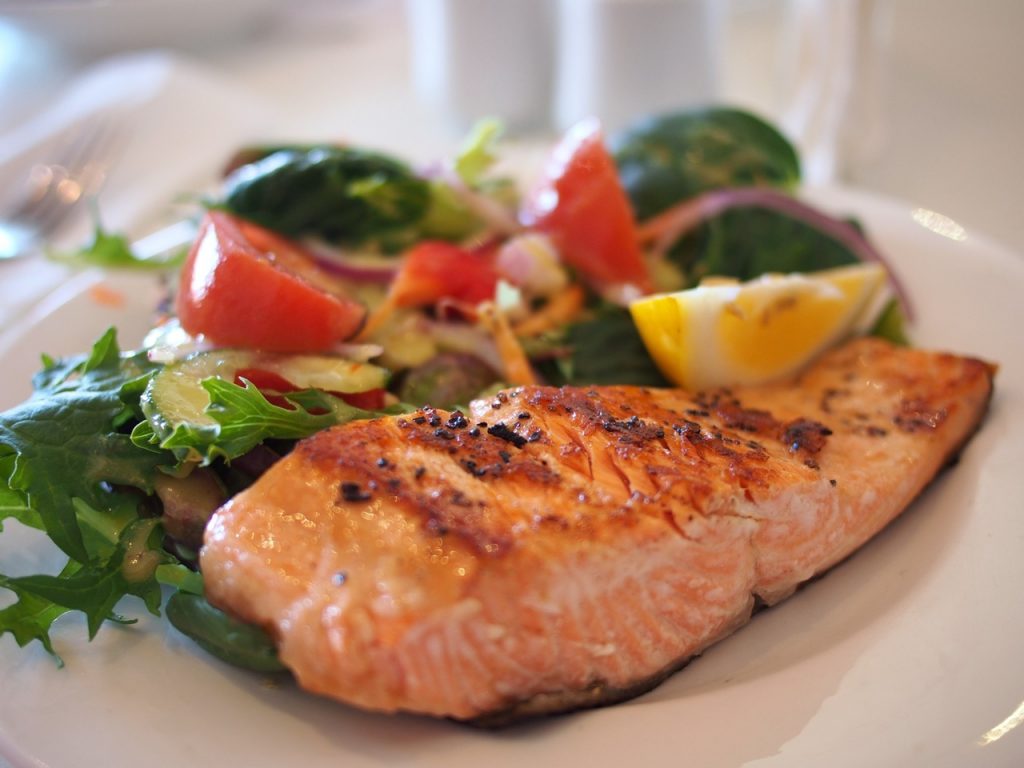
The Salmon and Leafy Greens (200 Calories):
Rich in essential amino acids, omega-3 fatty acids, and key micronutrients. Insulin stays flat and stable. Satiety hormones (like peptide YY and leptin) signal directly to your brain that you are fully nourished.
Your body burns the energy steadily while reducing systemic inflammation.
A calorie is simply a unit of heat energy measured in a laboratory. It tells you nothing about how that food affects your hormones, your appetite, or your metabolic rate.
Calorie Counting vs. Nutrition: My Personal Insights & Core Philosophy
Over 28 years ago, following a challenging divorce, I found myself carrying 28 lbs of excess body fat—including an extra 8 inches around my waist. Standing upright, I literally could not see my toes. Desperate to regain my health, confidence, and energy, I began looking for natural, lasting weight loss solutions.

My own experience with calorie counting probably isn’t what you’d expect.
After my divorce, when I was living alone, I actually counted my daily calories to make sure I was getting enough — not because I was trying to restrict them.
Coffee kept me going. My usual tradesman’s brew — white with two sugars — worked out at roughly 100 calories a cup. Ten cups during the day meant around 1,000 calories were going into me from coffee alone.
It wasn’t an exact science. The amount and type of milk varied, teaspoons of sugar aren’t precision measuring instruments, and I certainly wasn’t weighing every spoonful.
But that wasn’t the lesson.
Those were survival calories — not health-building calories.
I was getting energy into my body. What I wasn’t giving much thought to was the nutritional value attached to that energy.
That began to change when I changed the way I ate — and over the years it led me to ask a different question:
Not simply, “How many calories am I getting?” but “What am I actually getting for those calories?”
At the time, traditional calorie-counting programs like Weight-Watchers and Slimming World dominated the market. Yet, even without formal nutrition training at the time, my intuition told me their core systems were fundamentally flawed.
I had spent years watching friends and family struggle on strict calorie-controlled protocols. They faithfully counted every point, survived on low-fat “diet” foods, and used up endless willpower—only to achieve disappointing results, constant hunger, andeventual weight regain. While these programs offered “free foods,” their primary focus remained trapped on arbitrary calorie math rather than providing the **beneficial nutrients** required to revive a damaged metabolism and signal the body to burn stored fat.
Driven by my background and analytical training in engineering, I decided to step away from mainstream advice and solve the problem at the root.
I looked at my daily activity objectively. I was working a labor-intensive job, maintaining our home and garden, working on our car, and cooking regularly. How could someone so physically active store so much excess body fat?
That single question shifted everything. The problem wasn’t a lack of basic movement or an excess of total calories—it was the shift toward inflammatory, nutrient-void foods I had introduced into my diet over those eight years.
By applying a root-cause approach, I established the core philosophy that governs my work to this day:
The Core Philosophy:
Real fat loss involves looking beyond calories alone and considering the nutritional value of the foods providing them. Protein, essential fats, vitamins, minerals and other nutrients all have important roles that a calorie number by itself cannot describe.
Combine nutritious food with regular activity — including resistance training and, where appropriate, higher-intensity exercise — and you’re supporting much more than the number on the scales: muscle, fitness, metabolic health and your ability to manage your weight over time.
That early experience became part of a much longer learning process. I could see that changing the foods I ate and becoming active again was working long before I understood all the reasons why. Over the following 27+ years, I continued learning, testing and refining my approach to weight management, nutrition and fitness.
The lesson wasn’t that calories suddenly stopped mattering. It was that a calorie number tells you how much energy a food provides — not everything that food provides your body.
The Hidden Physiology: Nutrient Count vs. Calorie Count
Why does focusing on nutrition consistently outperform raw calorie counting for long-term weight loss? The answer lies in three key biological mechanisms:
1. The Thermic Effect of Food (TEF)
When you eat, your body expends energy simply digesting, absorbing, and processing those nutrients. However, different macronutrients require vastly different amounts of energy to digest: [New Jersey Agricultural Experiment Station]
- Protein: Burns roughly 20% to 30% of its caloric value during digestion. The complex chain of amino acids requires significant metabolic work to break down.
- Carbohydrates: Burns only 5% to 10%.
- Dietary Fats: Burns just 0% to 3%. [New Jersey Agricultural Experiment Station]
When you eat 100 calories of protein-rich food, your body nets only about 70–80 calories. When you eat 100 calories of refined sugar, your body nets nearly all 100 calories. Calorie counting completely ignores this metabolic tax.
2. Hormonal Satiety vs. Voluntary Willpower
Your appetite is governed by two master hormones: Ghrelin (the hunger signal) and Leptin (the fullness signal). [Serenity Health Care Centre]
Food composition can also influence satiety. Protein-rich foods, for example, tend to be more satiating than many highly processed foods, while minimally processed meals can provide combinations of protein, fats, micronutrients and food volume that help make a meal more satisfying.
Hormones involved in appetite regulation — including ghrelin, CCK and PYY — are part of this complex system. That’s another reason why two meals containing the same number of calories don’t necessarily produce the same experience of hunger and fullness.
3. Visceral Fat and Systemic Inflammation
The biggest danger of focusing solely on calories is that it encourages the consumption of ultra-processed “diet” products packed with synthetic preservatives, artificial sweeteners, and toxic seed oils.
These ingredients irritate the gut lining, driving chronic, low-grade inflammation. When your body is chronically inflamed, it elevates cortisol—the stress hormone that directly promotes the storage of visceral fat (the dangerous inflammatory fat stored deep around your abdominal organs). [Serenity Health Care Centre]
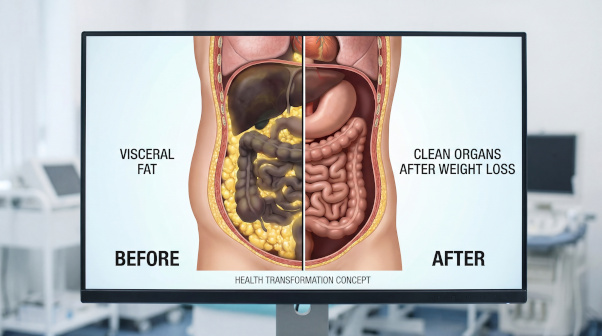
Visceral Fat Accumulation in the abdominal cavity can be reduced with an effective calorie controlled diet that focuses on whole foods rich in beneficial nutrients that boost your metabolic processes while reducing the storage of fats.
Beneficial nutrients (including amino acids) can reduce the stresses in life and your body to further reduce the storage of belly fat (both subcutaneous fat and visceral fat)
You cannot starve off visceral fat or stubborn belly fat if chronic inflammation is continually signaling your brain to hold onto energy reserves.
How Chronic Calorie Restriction Slows Your Metabolic Rate
When you aggressively cut calories without addressing food quality, your body perceives a state of famine. To protect itself, it initiates a series of biological defense mechanisms:
- Adaptive Thermogenesis: Your thyroid lowers output, causing your resting metabolic rate to drop significantly to conserve energy. (Denver Sports and Holistic Medicine)
- Lean Muscle Wasting: Without adequate protein and amino acids, your body breaks down lean muscle tissue for fuel, further depressing your daily caloric burn.
- Leptin Resistance: As leptin levels crash, your brain becomes convinced you are starving, driving overwhelming cravings for high-calorie, sugary foods. Serenity Health Care Centre
This is why traditional calorie counting diets almost always end in a plateau followed by rapid weight regain. (Serenity Health Care Centre)
The 3 Pillars of a Nutrition-First Approach to Fat Loss
If you want to eliminate stubborn belly fat naturally without tracking every morsel of food, shift your strategy from counting calories to maximizing nutrient density:
1. Prioritize High-Satiety Proteins and Healthy Fats
Protein provides the raw building blocks (amino acids) necessary to preserve lean tissue, repair gut linings, and maintain a high resting metabolic rate. Aim to include clean protein sources like pasture-raised eggs, wild fish, or grass-fed meats with every meal.
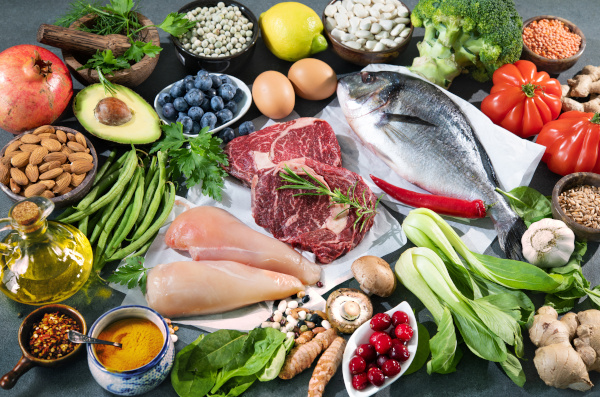
A healthy balanced diet rich in essential fats, proteins, amino acids and the all important micro-nutrients supports all the physiological processes you need to lose weight naturally.
Following a healthy balanced diet rich in the beneficial nutrients reduces your need to count calories (as discussed in my anti-inflammatory blueprint – 10 Secrets to Lose 10lbs
2. Flood Your System with Anti-Inflammatory Leafy Greens
Dark leafy greens (like spinach, kale, and Swiss chard) are packed with magnesium, potassium, and antioxidants. These micronutrients neutralize cellular oxidative stress, clear systemic inflammation, and help reduce fluid retention and stomach bloat within days.YY) and require more energy to break down during digestion (the thermic effect of food). This boosts your daily metabolic rate while protecting lean muscle mass during fat loss.
3. Eliminate Anti-Nutrients to Target Visceral Fat
Cutting out refined grains, industrial seed oils, and artificial sweeteners removes the primary drivers of gut inflammation. As inflammatory stress subsides, cortisol drops, allowing your body to mobilize and burn stubborn visceral fat for fuel.
Stop Counting, Start Nourishing: Your Next Step
Weight loss shouldn’t feel like a daily battle against your own biology. When you stop obsessing over restrictive calorie counting and start prioritizing rich, anti-inflammatory nutrition, your body rewards you: energy surges, bloat disappears, and natural fat loss occurs as a side effect of restored health.
READY TO PUT THIS INTO ACTION?
Download our free guide: The 10-in-10 Simple, Anti-Inflammatory Blueprint for Rapid Fat Loss.
Inside, you’ll discover:
- The exact food-swap matrix to replace inflammatory carbs with nutrient-dense options.
- How to structure satisfying 15-minute meals that boost your metabolic rate.
- A simple, step-by-step roadmap to shed 10lbs of stubborn belly fat naturally.
Calorie Counting vs Nutrition Summary….
Calories matter because energy balance matters. But that doesn’t mean everybody needs to spend their life counting them.
Calorie tracking can be a useful tool for understanding how much energy you’re consuming. What it cannot tell you on its own is the nutritional quality of that food, how filling you’ll find it, how much protein or essential micronutrients it provides, or how easily that way of eating will fit into your life.
That’s why my own focus gradually moved from simply asking “How many calories?” to asking “What am I actually getting for those calories?”
I don’t routinely count calories today. The calories haven’t stopped existing — I’ve simply found that I don’t need to count every one of them to manage my weight.
Is it time for you to stop counting calories and start focusing on food quality instead?
Frequently Asked Questions About Calorie Counting
Does calorie counting work for long-term weight loss?
Calorie counting can work as a weight-management tool if it helps you understand and control your overall energy intake. But counting calories isn’t the only way to create an appropriate energy balance, and it doesn’t tell you everything about the nutritional quality of the foods you’re eating.
For long-term weight management, I prefer to look at the bigger picture — including food quality, protein, satiety, activity, sleep and sustainable eating habits. The aim isn’t to pretend calories don’t matter. It’s to develop an approach that doesn’t necessarily require you to count every one of them.
Why am I counting calories and still not losing belly fat?
Counting calories doesn’t guarantee weight loss. Your actual energy intake may differ from your estimates, portion sizes can be difficult to judge accurately, and changes in activity, appetite and body weight can all affect how much energy you need.
The scales can also be influenced by water retention, glycogen and digestive contents, which can sometimes mask changes in body fat over shorter periods.
If belly fat is your concern, look beyond the calorie number alone. Food quality, protein intake, satiety, sleep, stress and regular physical activity can all form part of a sustainable weight-management approach
Do calories matter at all for weight loss?
Yes. Calories matter because changes in body weight are influenced by energy balance — the relationship between the energy you consume and the energy your body uses.
But calories aren’t the whole nutritional story. Two foods providing the same number of calories can differ considerably in their protein, fats, vitamins, minerals and other nutrients, as well as how filling you find them.
So the question isn’t really “calories or nutrition?” Both matter. My approach is to prioritise nutritious, satisfying foods while remaining aware that total energy intake still plays an important role in weight management.
Why do I stop losing weight on a low-calorie diet?
Weight loss doesn’t always continue at the same rate. As you lose weight, your body generally requires less energy, and prolonged calorie restriction can also produce adaptive changes in energy expenditure. This means the calorie intake that produced weight loss earlier may not produce exactly the same rate of loss later.
Changes in activity, appetite, portion sizes and adherence can also contribute, while fluctuations in water and glycogen can temporarily hide changes in body fat on the scales.
A slowdown doesn’t necessarily mean your metabolism is “broken.” It may simply be time to reassess your food intake, nutritional quality, activity and overall approach rather than automatically cutting calories further.
How quickly can shifting to nutrient-dense foods reduce bloat?
It varies from person to person and depends partly on what’s causing the bloating in the first place. Changes in carbohydrate intake, sodium, hydration and the amount and type of food you’re eating can all affect water retention and digestive contents, so the scales and your waistline can sometimes change quite quickly.
However, a rapid reduction in weight or bloating shouldn’t automatically be interpreted as rapid fat loss. Early changes can include shifts in water, glycogen and digestive contents as well as changes in body fat over time.
I’ve personally seen my weight drop by around 3lbs in less than 24 hours after combining a lower-carbohydrate diet with fasting and a short HIIT session. I don’t regard that as 3lbs of body fat disappearing overnight — it was a short-term scale change, with water and glycogen likely contributing substantially.
That’s why it’s important to distinguish rapid changes on the scales from actual fat loss. Sustainable weight management is about what happens over weeks, months and years — not simply what the scales show tomorrow morning.
How do amino acids help with fat loss?
Essential amino acids from quality protein sources trigger the release of satiety hormones (like PYY) and require more energy to break down during digestion (the thermic effect of food). This boosts your daily metabolic rate while protecting lean muscle mass during fat loss. Denver Sports and Holistic Medicine
Other amino acids actively help with sleep (Tryptophan), enabling your body to rest and heal overnight. Tryptophan is also involved in appetite regulation and nutrient absorption. Methionine is actively engaged in metabolism and growth, aids absorption of essential minerals zinc and selenium and acts as an antioxidant to help cleanse the body of harmful toxins.
The amino acid Threonine is the main component of the structural proteins collagen and elastin. If you have ever suffered from rough ‘cauliflower-like’ skin, joint problems etc then I suggest you take a closer look at your diet for these essential amino acids including threonine.